Scientific publication: “Electron-beam radiolysis of ultrathin AlF3 films on graphite: Secondary-electron effects and self-limiting kinetics”

DOI: 10.1021/acs.langmuir.6c04491
Langmuir, 2nd Nov. 2026

Heidy Stefany Betancourt-Infante; Adriana Elizabeth Candia; Silvia Susana Montoro; Sindy Julieth Rodríguez-Sotelo; Mario César Guillermo Passeggi; Fernando José Bonetto; Gustavo Daniel Ruano

Abstract:

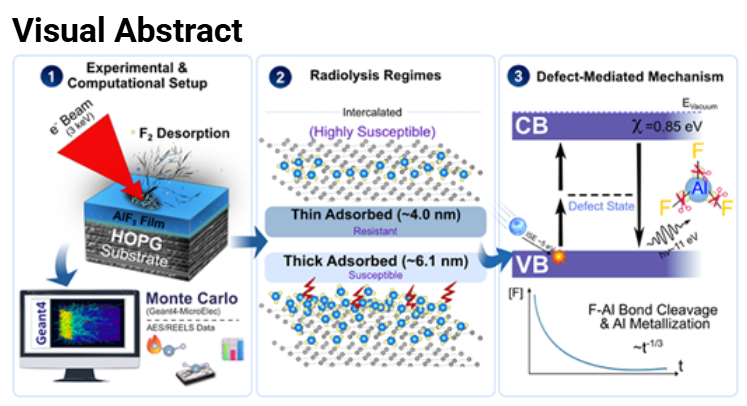
The mechanisms governing electron-induced decomposition in aluminum trifluoride (AlF3), a wide-band-gap ionic material with potential applications as an inorganic electron-beam resist, remain poorly understood. This study investigates the radiolysis of ultrathin AlF3 films on graphite substrates through a combination of experimental characterization and Monte Carlo simulations. We identify a nonmonotonic dependence of electron-beam-induced radiolysis efficiency on film thickness and growth regime, which correlates with thickness-dependent changes in the internal secondary electron spectrum. The decomposition follows power-law kinetics with an exponent ≈−1/3, consistent with self-limiting, evolving radiolysis kinetics. We propose a defect-mediated, self-limiting mechanism in which irradiation-induced defect states provide alternative lower-energy relaxation pathways that may progressively reduce further bond-breaking events as irradiation proceeds. This framework is also consistent with independent radiolysis data for cryolite (Na3AlF6). Furthermore, we provide a validated dielectric model for AlF3 implemented in the Monte Carlo-based Geant4 MicroElec framework, enabling accurate simulation of electron-beam interactions in this material for broader nanofabrication and radiation effect studies.
Scientific publication: “Neuromorphic impedance signatures and oxygen-related interfacial dynamics in Pt/YBCO memristive junctions”

DOI: 10.1021/acsaelm.6c01363

ACS Appl. Electron. Mater. 2026, 8, 9006−9019, cover, 25th Sep. 2026

Esteban A. Rodríguez, Hannu Huhtinen, Petriina Paturi, Myriam H. Aguirre, and Carlos Acha

Abstract

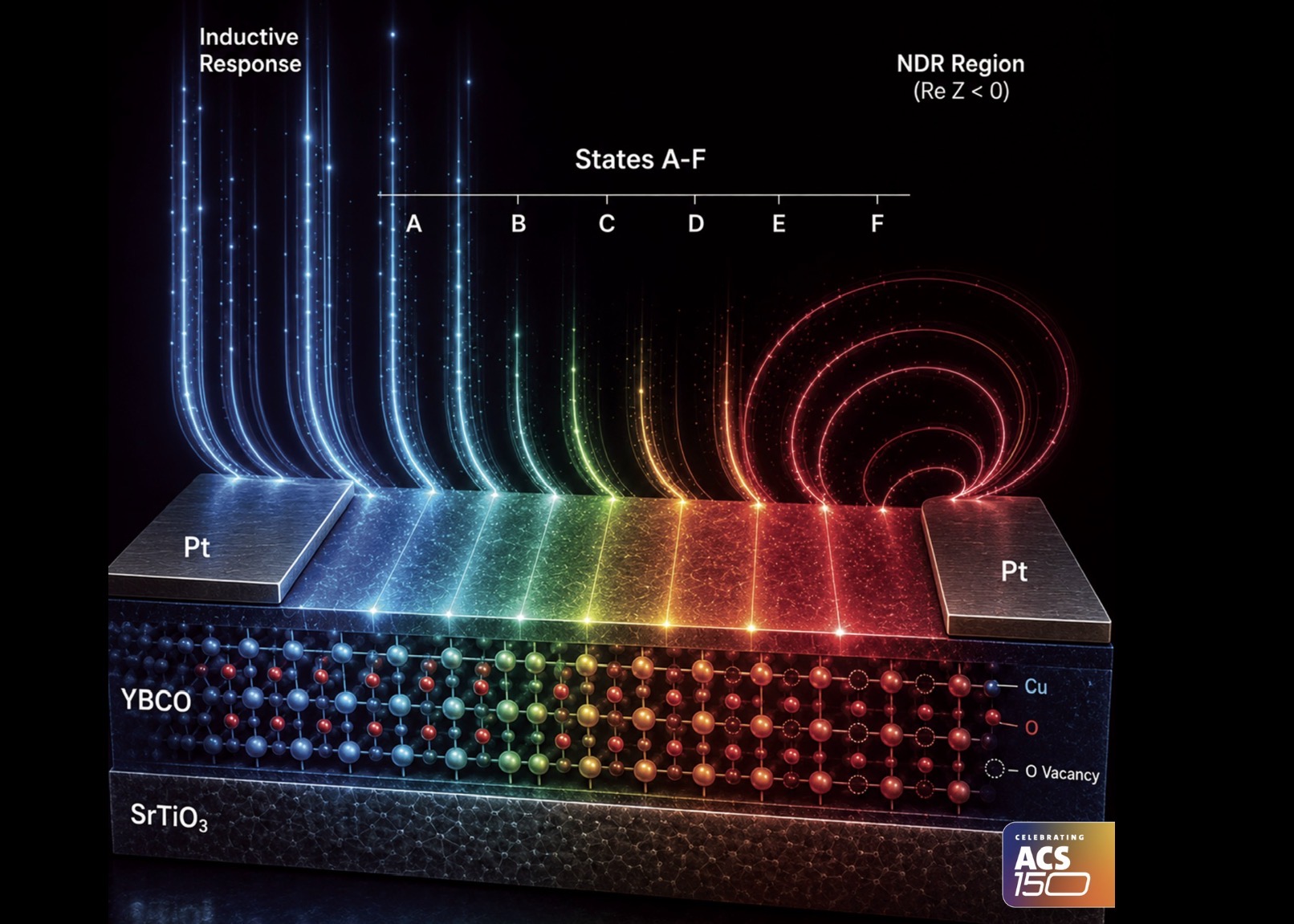
Memristive junctions based on high-temperature superconducting cuprates are promising building blocks for oxide-based neuromorphic electronics; however, the small-signal dynamics underlying their state-dependent behavior remain largely unexplored. Here, we use zero-bias impedance spectroscopy (IS) to probe memristive Pt/YBa2Cu3O7–δ (YBCO) junctions programmed into a series of nonvolatile resistive states along and beyond the resistive hysteresis switching loop (RHSL). Over the full temperature range (80–300 K) and for every state, the response is well captured by equivalent-circuit models built from two interfacial blocks, consistent with the two-interface picture of bipolar resistive switching. The low-resistance state requires an interfacial element with a negative-resistance branch, in which a negative differential resistance (NDR) is limited by a slow internal variable acting as a chemical inductance; intermediate states are described by two parallel-RC relaxations whose parameters evolve consistently with a progressive depletion of the interfacial oxygen content. Upon further programming toward high resistance, the most resistive states develop a qualitatively distinct signature, with the Bode phase dropping below –90° as the negative-resistance branch becomes dominant. We interpret this crossover as compatible with two regimes of the coupled ionic–electronic dynamics: a slow response set by the scarcity of oxygen vacancies and a faster one enabled by their abundance. Cross-sectional scanning transmission electron microscopy of an electrically overstressed junction reveals a crystalline-to-amorphous degradation pathway that bounds the structural changes compatible with the milder switching explored here. These results are consistent with field-driven oxygen redistribution at the Pt/YBCO interface acting as the control parameter of both the accessible resistance states and the emergence of impedance responses with a negative-conductance band, and they identify the small-signal spectroscopic fingerprint of a FitzHugh–Nagumo (FHN)-like circuit topology in a complex-oxide memristive junction.

Cover

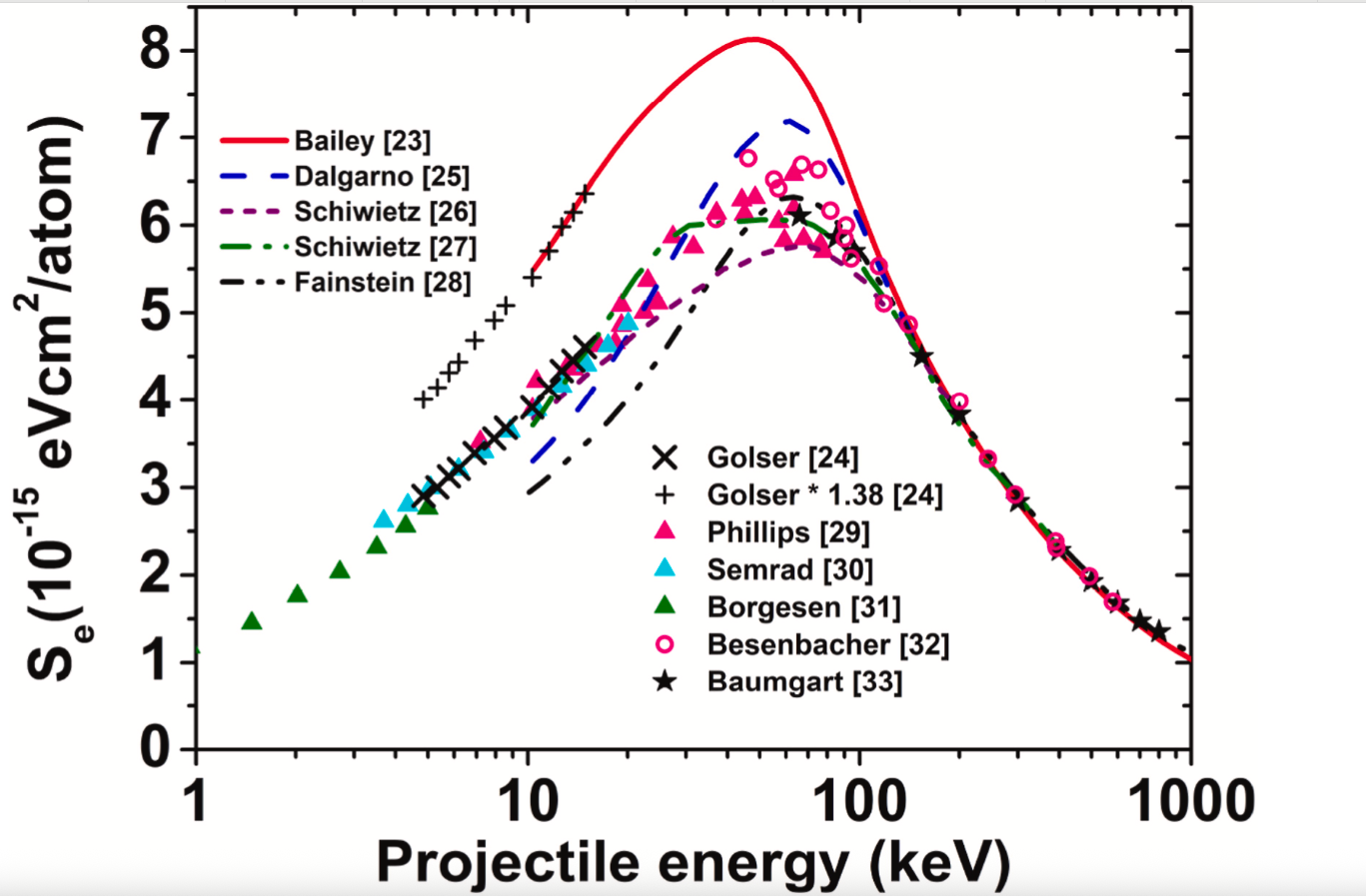
Scientific publication: “A real time in situ method for quantifying hydrogen accumulation in thin solid films using ion energy loss spectroscopy”

DOI: 10.1016/j.ijhydene.2026.154179

International Journal of Hydrogen Energy, Volume 221, 27 March 2026, 154179

Mario Mery, Vladimir A. Esaulov, Carlos García, Jorge E. Valdés

Published by Elsevier Ltd on behalf of Hydrogen Energy Publications LLC. This is an open access article under the CC BY license (http://creativecommons.org/licenses/by/4.0/ )

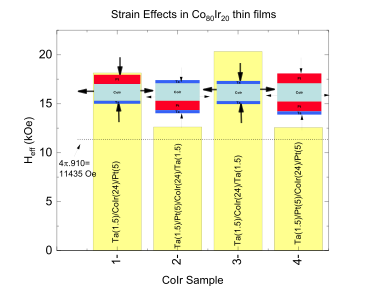
Chilean Partner Institution Strengthens International Collaboration in Nanoscience and Magnetic Devices Through Participation in European ULTIMATE-I Project

Universidad Técnica Federico Santa María strengthened its international scientific collaboration through its participation in the European research project ULTIMATE-I, an initiative funded by the European Union that brought together institutions from Spain, France, Serbia, Argentina, Chile, Peru, and the United States in the field of advanced nanoscience and spintronic technologies.

As one of the project’s partner institutions, USM played an important role in developing research on ultra-thin magnetothermal sensors based on advanced magnetic materials. The initiative also provided international training opportunities for doctoral students at the university, enabling them to undertake extended research stays at leading European laboratories and research centres.

The collaboration involved researchers and students from the Department of Physics, including Carlos García and PhD students Fernando Soto, Paul Carvajal, and Manolo Cardona, who participated in collaborative research activities in Spain and France. During their stays abroad, the students worked with advanced fabrication and characterisation techniques for thin films and spintronic devices while integrating into international research teams and accessing high-level scientific infrastructure.

According to Professor García, the project represented an important milestone for the internationalisation of scientific research at USM. Beyond the scientific results, the initiative helped create long-term academic networks and strengthened cooperation between Latin American and European institutions working in nanomagnetism and advanced materials.

The experience gained through ULTIMATE-I also opened new opportunities for USM students and researchers. One of the most significant outcomes was the advancement of a dual-degree process between USM and the Université de Lorraine in France, involving student Damián Melo.

Following the completion of the project, USM’s Applied Magnetism Group began preparing new Horizon Europe proposals with a stronger focus on applied research and industry collaboration, further consolidating the university’s international presence in nanoscience, advanced materials, and spintronics research.

https://usm.cl/noticias/usm-consolida-colaboracion-internacional-en-nanociencia-tras-participacion-en-proyecto-europeo-ultimate-i

Participation in Intermag 2026 (Manchester, UK)

IEEE International Magnetics Conference (INTERMAG 2026), Manchester (UK), from 13th to 17th April

Dante Peluso (CONICET); poster presentation: “Thermomagnetic properties of mixed-valence La1-xSrxMnO3 manganite films near the x = 0.2 morphotropic phase boundary”; authors: D. Peluso, M. A. Rengifo, J. Santiso, M. Aguirre, S. Di Napoli, M. Quintero

Luis Avilés (CONICET); poster presentation: “Crystallographic orientation dependence of the anisotropic magnetoresistance in epitaxial Fe100-xCox thin films”; authors: L. Saba, A. Paz, W. Painado Lozano, A. Gutarra, L. León Hilario, D. Pérez Morelo, D. González-Chávez, J. Gómez, A. Butera, M. Granada, L. Avilés Félix

Lara Solís (CNEA); poster presentation: “Substrate-controlled strain and magnetic anisotropy in epitaxial YIG films”; authors:  L. M. Solís, J. Santiso, F. Bonetto, P. Vavassori, J. Rojas-Sánchez, S. Petit-Watelot, L. Steren, M. Aguirre